This was part of last weekend’s edition of The IKN Weekly. Just one small edit, the name of a company at the end.
More on
Lead (Pb)
Lead (Pb)
It was
hectic and a bit of a squeeze to get the edition out on time last week, since
then I’ve had time to fill in some blank spaces and none more so than the
intriguing situation in the lead market. What I’ve found by checking the data
is that there’s every reason to suppose an acceleration in the demand for lead
that justifies the current voracious appetite of smelters for product.
hectic and a bit of a squeeze to get the edition out on time last week, since
then I’ve had time to fill in some blank spaces and none more so than the
intriguing situation in the lead market. What I’ve found by checking the data
is that there’s every reason to suppose an acceleration in the demand for lead
that justifies the current voracious appetite of smelters for product.
The place
to go for reliable supply demand data is the International Lead and Zinc Study
Group (ILZSG), based out of Portugal and comprised of a selection of industry
experts from all corners of the sector. We’ve made use of their database (22)
on these pages previously for the zinc exercise which showed in 2016 the rise
in demand (that’s worked out very nicely thank you) and it’s now time for its
ugly sister, known in Latin as plumbum and the reason we call out the plumber
who’ll often bring his plumb line. This chart derived from the data shows the
supply make-up of Pb and the first thing to note is the high percentage of end
user supply that comes from the re-cycling business. There are well-established
firms that do this and as much as 97% of the lead used in car batteries is
scavenged and sent back to battery makers to use again. However, mined supply
is also on the rise and with 11 months of data for 2017 already published, our
estimated as seen in the charts is likely to be within a tight margin of error
and shows supply expanding again after a couple of stagnant years.
to go for reliable supply demand data is the International Lead and Zinc Study
Group (ILZSG), based out of Portugal and comprised of a selection of industry
experts from all corners of the sector. We’ve made use of their database (22)
on these pages previously for the zinc exercise which showed in 2016 the rise
in demand (that’s worked out very nicely thank you) and it’s now time for its
ugly sister, known in Latin as plumbum and the reason we call out the plumber
who’ll often bring his plumb line. This chart derived from the data shows the
supply make-up of Pb and the first thing to note is the high percentage of end
user supply that comes from the re-cycling business. There are well-established
firms that do this and as much as 97% of the lead used in car batteries is
scavenged and sent back to battery makers to use again. However, mined supply
is also on the rise and with 11 months of data for 2017 already published, our
estimated as seen in the charts is likely to be within a tight margin of error
and shows supply expanding again after a couple of stagnant years.

When it
comes to demand, there are a few extra uses for the metal out there such as
electrical cable wrap (around 6% of supply) and ammunition (shot takes around
3% of the supply) and there’s even lead still put in some fuels and paints
around the world (long past time to stop that, people) but the main use for the
metal by a long way is for lead/acid batteries, taking around 80% of all the
metal out there. Therefore when we talk lead demand we’re talking about cars,
trucks, all types of moving vehicles and look no further for the demand driver
(and therefore the reason for price changes. On this score, let’s take the
aggregate supply as seen in the above chart and place it next to the demand
columns for the same years (plus the ILXSG forecast for 2018 added in for
reference) but please note the cut down Y-axis, which I’ve done to show
surplus/deficit differences more clearly and not to try and fool your eye.
comes to demand, there are a few extra uses for the metal out there such as
electrical cable wrap (around 6% of supply) and ammunition (shot takes around
3% of the supply) and there’s even lead still put in some fuels and paints
around the world (long past time to stop that, people) but the main use for the
metal by a long way is for lead/acid batteries, taking around 80% of all the
metal out there. Therefore when we talk lead demand we’re talking about cars,
trucks, all types of moving vehicles and look no further for the demand driver
(and therefore the reason for price changes. On this score, let’s take the
aggregate supply as seen in the above chart and place it next to the demand
columns for the same years (plus the ILXSG forecast for 2018 added in for
reference) but please note the cut down Y-axis, which I’ve done to show
surplus/deficit differences more clearly and not to try and fool your eye.

As you can
see, supply and demand were reasonably lockstep for the five years to 2016, but
2017 saw it move into a deficit and with the ILZSG predicting further demand
growth for this year, we should expect more pressure to deliver. What’s more,
if we scratch around at some of the underlying data we see details of the demand
hike.
see, supply and demand were reasonably lockstep for the five years to 2016, but
2017 saw it move into a deficit and with the ILZSG predicting further demand
growth for this year, we should expect more pressure to deliver. What’s more,
if we scratch around at some of the underlying data we see details of the demand
hike.

This chart right shows the quarterly net imports of lead into China (the
world’s leading user of Pb, which is another way of saying that it makes the
most car batteries). Inside the numbers included in that China chart are other
intriguing datapoints too, such as the way in which up to 2016 China exports
more pure refined Pb than imported (around 11,000 tonnes), but last year the
numbers flipped and they imported a net of 77,000 tonnes).
world’s leading user of Pb, which is another way of saying that it makes the
most car batteries). Inside the numbers included in that China chart are other
intriguing datapoints too, such as the way in which up to 2016 China exports
more pure refined Pb than imported (around 11,000 tonnes), but last year the
numbers flipped and they imported a net of 77,000 tonnes).
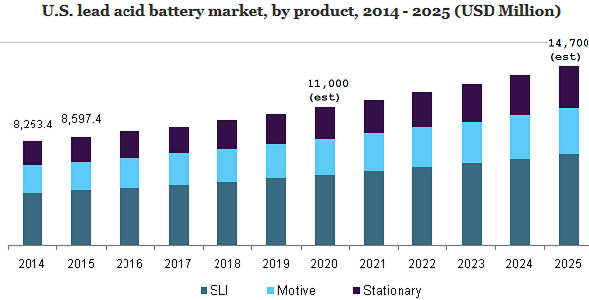
My
final exhibit today is a chart from a report compiled by Grandview
Research (23) from 2016 which shows the lead/acid battery market for the USA
only, which is set to grow substantially in the years to come with two of the
forecasts added in for your consideration. It may be counter-intuitive what
with the rise and rise of lithium batteries, but traditional lead/acid units
aren’t about to go out of style whether they be SLI (starting, lighting and
ignition, what we consider a “normal car battery”), motive (e,g, the large
banks of batteries used by fork lift trucks and the like) or stationary (which
are seeing growth due to the need to store alternative power, such as solar).
final exhibit today is a chart from a report compiled by Grandview
Research (23) from 2016 which shows the lead/acid battery market for the USA
only, which is set to grow substantially in the years to come with two of the
forecasts added in for your consideration. It may be counter-intuitive what
with the rise and rise of lithium batteries, but traditional lead/acid units
aren’t about to go out of style whether they be SLI (starting, lighting and
ignition, what we consider a “normal car battery”), motive (e,g, the large
banks of batteries used by fork lift trucks and the like) or stationary (which
are seeing growth due to the need to store alternative power, such as solar).
The bottom
line: The lead market has quietly grown to the point where it’s tighter than
the headline-grabbing zinc market and the likelihood is that Pb’s run is far
from over. All the more reason to like (company name), in my view.
line: The lead market has quietly grown to the point where it’s tighter than
the headline-grabbing zinc market and the likelihood is that Pb’s run is far
from over. All the more reason to like (company name), in my view.